The Impact of Product Design on the Powder Coating Process
Powder coating is one of the most widely used finishing methods for metal products because it offers excellent durability, corrosion resistance, and a clean, professional appearance. However, achieving a high-quality powder-coated finish depends on more than just selecting the right powder or applying it correctly.
One factor that is often overlooked is product design. In reality, many of the challenges encountered during the powder coating process originate long before the product reaches the coating line. The shape, dimensions, structural features, and overall geometry of a product can significantly influence how efficiently powder coating is applied and how consistent the final finish will be.
By considering powder coating requirements during the design stage, manufacturers can improve coating quality, increase production efficiency, and reduce costly rework.
Why Does Product Design Affect Powder Coating?
Unlike conventional liquid paint, powder coating is applied using an electrostatic process. Powder particles are electrically charged and sprayed onto a grounded metal surface before being cured in an oven to form a durable protective coating.
Because this process relies on electrostatic attraction and spray accessibility, the geometry of a product plays an important role in determining coating performance.
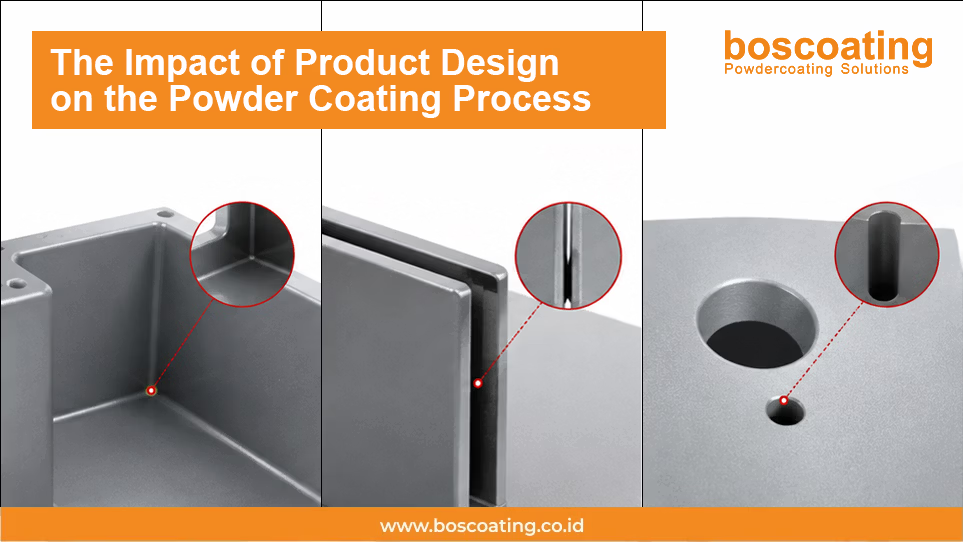
Products with open and accessible surfaces generally receive a more uniform coating. On the other hand, products with deep recesses, narrow gaps, or enclosed spaces may be more difficult to coat evenly.
In other words, good product design not only simplifies manufacturing but also contributes directly to achieving a more consistent powder-coated finish.
Product Features That Are Difficult to Powder Coat
Not every part of a product presents the same level of difficulty during powder coating. Certain design features naturally make the application process more challenging. Some common examples include:
- Deep inside corners.
- Narrow gaps between components.
- Deep recesses or box-shaped cavities.
- Small holes with significant depth.
- Enclosed hollow sections.
- Closely spaced brackets or structural members.
- Folded sheet metal with limited spray access.
The more difficult these areas are to reach with a spray gun, the greater the possibility of uneven coating thickness.
Understanding the Faraday Cage Effect
One of the most common technical challenges in powder coating is the Faraday Cage Effect.
This phenomenon occurs when electrostatic forces cause powder particles to accumulate around the outer edges of deep corners or recessed areas rather than reaching the interior surfaces. As a result, the outer edges may receive a heavier coating while the inner areas receive insufficient coverage.
For example, a fabricated steel box with a deep cavity is generally more difficult to coat uniformly than a flat metal panel.
Although experienced powder coating operators can reduce this effect by adjusting voltage settings, air pressure, and spray techniques, product design remains one of the most effective ways to minimize the problem.
Provide Adequate Access for the Spray Gun
In addition to product geometry, accessibility for the powder coating operator is another important design consideration. The spray gun requires sufficient space to reach all surfaces of the product effectively. If certain areas are too narrow or enclosed, applying an even coating becomes much more difficult.
Examples of challenging designs include:
- Extremely narrow internal corners.
- Deep box-shaped structures.
- Brackets positioned too close together.
- Narrow enclosed cavities.
- Components that block access to surrounding surfaces.
Providing enough clearance during the design stage allows the spray gun to operate more effectively, improving coating consistency while increasing production efficiency.
The Importance of Drain and Vent Holes
For products that use steel tubing or hollow structural sections, drain and vent holes should never be overlooked. Although these openings may appear to be minor design details, they serve several important functions throughout the powder coating process.
They help:
- Drain pretreatment chemicals after cleaning.
- Improve rinsing efficiency.
- Accelerate drying before coating.
- Release expanding air during the curing process.
- Reduce pressure buildup inside enclosed hollow sections.
Without adequate drainage and ventilation, trapped liquids or air may interfere with the coating process and affect the overall quality of the finish.
Avoid Excessively Sharp Edges
Avoid Excessively Sharp Edges
During electrostatic application, powder particles tend to deposit more easily on larger flat areas than on sharp corners. Over time, these thinner edge coatings may become more susceptible to wear, impact, or corrosion.
Where practical, incorporating small radii into the product design can improve coating distribution without affecting the product's intended function.
Consider Hanging Points During the Design Stage
During the powder coating process, products are typically suspended from an overhead conveyor system using metal hooks. Unfortunately, suitable hanging locations are often overlooked until the product has already been manufactured.
Proper hanging point design influences several aspects of the coating process, including:
- Product stability during coating.
- Ease of spray gun access.
- Complete coating coverage.
- Visibility of hook marks after coating.
- Smooth transportation through the coating line.
Providing appropriate hanging points during the design stage helps improve both coating quality and production efficiency.
Collaboration Between Designers, Fabricators, and Powder Coating Specialists
Collaboration Between Designers, Fabricators, and Powder Coating Specialists
Product designers typically focus on functionality and appearance, while fabrication teams prioritize manufacturability. Powder coating specialists, on the other hand, understand how specific design features influence surface preparation, coating application, and curing.
By collaborating during the design phase, potential coating challenges can often be identified before fabrication begins. Even relatively small design adjustments—such as adding a drain hole or repositioning a bracket by a few millimeters—can significantly improve coating quality while reducing manufacturing costs.
This collaborative approach has become increasingly common in modern manufacturing because it produces products that are easier to manufacture, easier to finish, and more consistent in quality.
Common Design Mistakes That Make Powder Coating More Difficult
Several design decisions can unintentionally complicate the powder coating process. Some of the most common include:
- Omitting drain and vent holes in hollow sections.
- Using excessively sharp edges throughout the design.
- Creating gaps that are too narrow for effective spray access.
- Failing to provide suitable hanging points.
- Designing deep enclosed boxes without considering coating accessibility.
- Placing components too close together, restricting powder distribution.
Most of these issues can be avoided simply by considering powder coating requirements during the early stages of product design.
Tips for Designing Products for Powder Coating
If a product is intended to receive a powder-coated finish, the following design recommendations can help improve the final result:
- Avoid unnecessarily narrow gaps.
- Use rounded edges wherever practical.
- Include drain and vent holes in hollow sections.
- Provide strong and accessible hanging points.
- Allow sufficient clearance for the spray gun.
- Consult your powder coating provider before fabrication begins.
Planning for powder coating during the design stage is almost always more efficient than modifying a product after manufacturing has been completed.
Conclusion
A successful powder coating process begins long before the product enters the coating line. Product design has a direct influence on coating accessibility, application efficiency, and the overall quality of the finished surface.
Factors such as product geometry, spray gun access, hanging points, drain holes, and edge design all contribute to the consistency and durability of the final coating. By incorporating powder coating requirements into the design process, manufacturers can produce components that are easier to coat, require less rework, and deliver a more professional appearance.
Through close collaboration between designers, fabricators, and powder coating specialists, manufacturers can achieve products that are not only structurally sound good but also feature durable, high-quality finishes built to perform in demanding industrial environments.